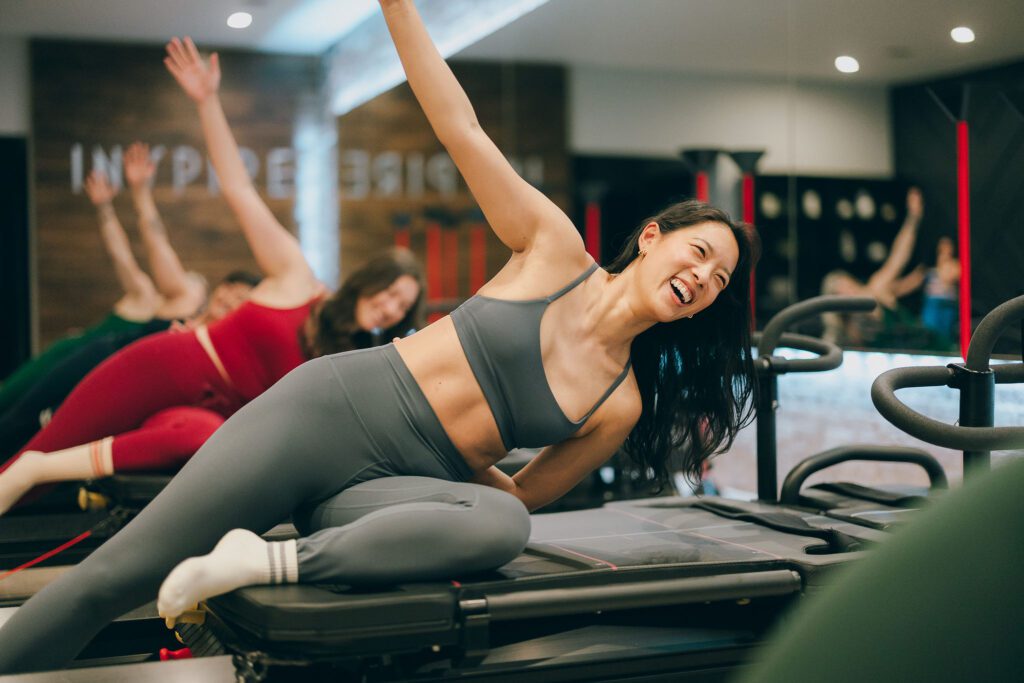
Many people walk out of their first Lagree class with the same thought: “That was way harder than I expected.” Even individuals who are already in good shape are often surprised by how challenging the workout feels.
The difficulty of Lagree isn’t accidental. The Lagree Method was intentionally designed to push muscles to fatigue through slow, controlled resistance training. While the movements may appear simple at first glance, the way they are performed creates a unique training stimulus that challenges strength, endurance, and stability all at once.
Understanding why Lagree feels so difficult can help you appreciate why it produces such powerful results.
Slow Movement Increases Muscle Demand
One of the defining features of Lagree workouts is the emphasis on slow, controlled movement. In many traditional workouts, repetitions are performed quickly, allowing momentum to help move the weight.
Lagree eliminates momentum by slowing down each movement. When exercises are performed slowly, muscles must remain engaged throughout the entire range of motion.
This extended engagement forces muscles to work harder and longer than they would during faster exercises. As a result, the muscles fatigue more quickly, which is why the workout can feel intense even when the movements appear small.
Time Under Tension
Another key reason Lagree workouts feel so challenging is the concept of time under tension. This means muscles remain activated continuously rather than relaxing between repetitions.
In traditional strength training, muscles often get brief moments of rest between each repetition. In Lagree, however, the muscles stay under constant tension throughout the exercise.
This continuous activation increases the workload placed on the muscles and forces them to maintain effort for longer periods of time. As fatigue builds, the body recruits additional muscle fibers to maintain control of the movement.
This process contributes to the intense muscle fatigue many people experience during class.
The Famous Lagree Muscle Shake
If you’ve taken a Lagree class, you’ve probably experienced the unmistakable muscle shake that happens during certain exercises. While it may feel surprising at first, muscle shaking is actually a positive sign that your muscles are working hard.
The shaking occurs when muscle fibers begin to fatigue and the nervous system recruits additional fibers to maintain the movement. This recruitment process creates small oscillations in the muscle, which appear as shaking.
Rather than being a sign of weakness, the shake indicates that the muscles are reaching the level of effort required to stimulate strength and endurance improvements.
Full-Body Muscle Engagement
Another reason Lagree feels so challenging is that it engages multiple muscle groups simultaneously. Many traditional workouts isolate a single muscle group at a time.
Lagree exercises often require several muscles to work together during each movement.
For example, a single exercise might involve the:
- Core stabilizers
- Glutes and hamstrings
- Quadriceps
- Shoulder stabilizers
- Back muscles
Because multiple muscle groups are working at once, the body must generate greater overall effort to maintain control of the movement.
This full-body engagement increases both muscular fatigue and calorie expenditure.
The Moving Platform Challenge
Lagree workouts are performed on the Megaformer, a specialized machine designed to create continuous resistance throughout each movement. The carriage of the Megaformer moves along rails while springs provide adjustable resistance.
Because the platform moves, your body must constantly stabilize itself while performing exercises. This instability forces smaller stabilizing muscles to activate alongside larger muscle groups.
These stabilizing muscles are often underused in traditional workouts, which is one reason Lagree can feel challenging even for experienced athletes.
High Intensity Without High Impact
Despite its intensity, Lagree remains a low-impact workout. The exercises are designed to challenge muscles deeply without placing excessive stress on the joints.
Unlike workouts that involve jumping or explosive movements, Lagree relies on slow, controlled resistance. This allows participants to push their muscles to fatigue while protecting the knees, hips, and spine.
Because of this low-impact design, many people are able to take Lagree classes multiple times per week without experiencing the joint strain associated with high-impact workouts.
Mental Focus and Control
Lagree workouts require a high level of concentration. Because the movements are slow and controlled, participants must focus on maintaining proper alignment and muscle engagement throughout each exercise.
This mental focus strengthens the connection between the brain and the muscles, often referred to as the mind-muscle connection.
Over time, this increased awareness helps improve movement quality and muscle activation.
Why the Challenge Leads to Results
The reason Lagree workouts feel so difficult is the same reason they produce such effective results. By pushing muscles to fatigue through controlled resistance and continuous engagement, Lagree training stimulates strength development and muscular endurance.
The body adapts to this challenge by becoming stronger, more stable, and more resilient.
As participants continue attending classes, they often notice improvements in strength, posture, balance, and overall conditioning.
Progress Over Time
The first few Lagree classes can feel particularly intense as the body adapts to the training style. Over time, however, participants typically notice increased endurance and greater control during exercises.
While the workouts remain challenging, the body becomes more efficient at managing the demands placed on it.
This gradual improvement is one of the most rewarding aspects of Lagree training.
Experience the Lagree Challenge at Inspire Seattle
At Inspire Seattle, Lagree classes are designed to deliver a challenging and efficient full-body workout. Each 40-minute class focuses on slow, controlled movements that strengthen muscles while protecting the joints.
Whether you are new to Lagree or looking to elevate your fitness routine, our instructors will guide you through every exercise and help you get the most out of your workout.
Book your first class and discover why Lagree workouts are known for delivering powerful results.